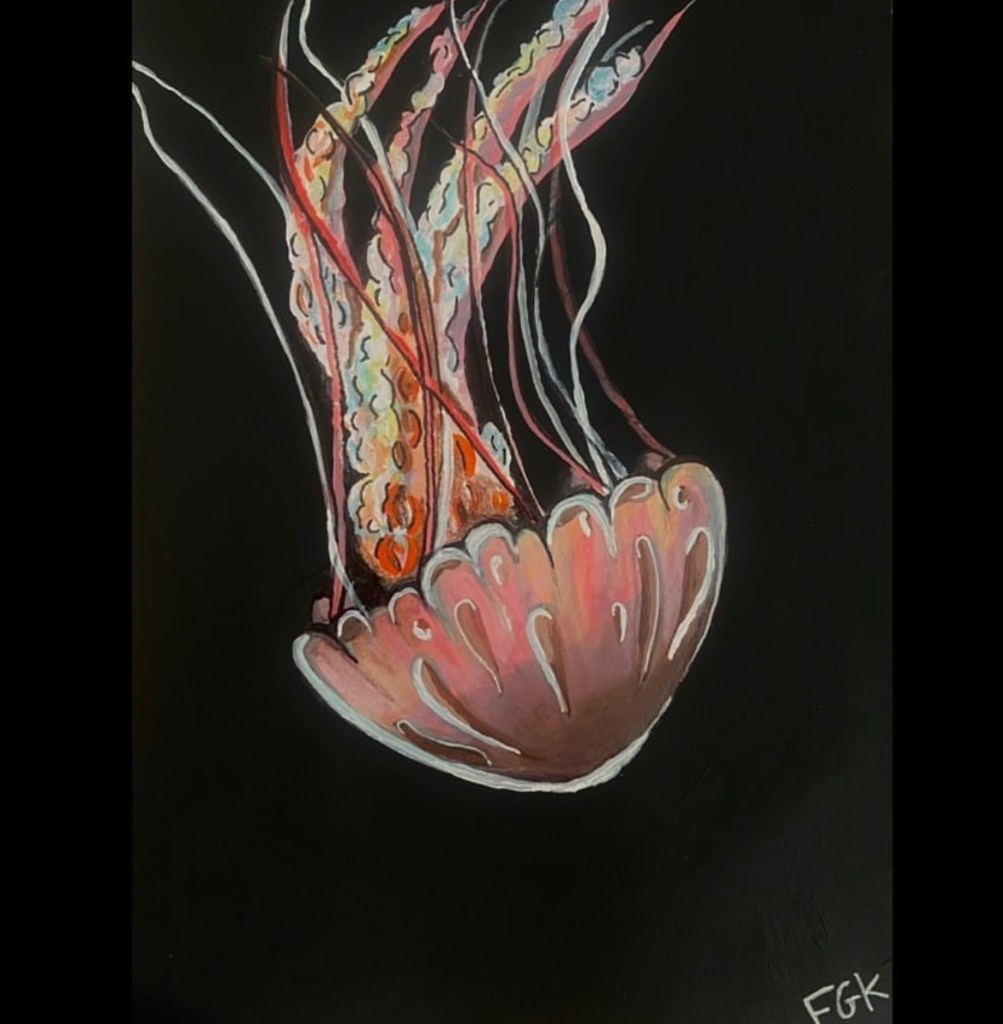
Upon my daily tradition of browsing BBC news I stumbled upon a news video created two years ago by Ruth Evans, Daniel Gordon and Tom Heyden titled ‘Microplastics, drugs and food- how jellyfish can help us’ (Evans, et al.. 2020). This sparked my interest: I thought jellyfish? We all know of the importance of marine species such as algae or phytoplankton, both environmentally and socially, but I had always dismissed jellyfish as not much more than annoyances that ruin your day at the beach. Subsequently, when stumbling upon this story which highlighted three areas where jellyfish can help us — plastic pollution, medicine and food sustainability — I was inspired to do some further digging.
Though our oceans face many challenges, one of the most pressing is the escalating invasion of our seas with microplastics. If you spend even one day at the beach this issue hits you right in the face. Or should I say feet, which become plastered with red, white and blue specs of plastic by the end of the day. Though this may seem like an exaggeration you just need to take one glance at a picture of the ‘great pacific garbage patch’ to realise the true scale of this issue. Yes, those dreams of sailing across a clear blue sea are now just a fantasy. The issue is not just visual but also poses serious health threats not only in marine organisms but also in ourselves (Shim, et al. 2015). Though this all sounds rather miserable there are things we can do to reduce the amount of plastic in the oceans. One example of this is by using jellyfish as shown in a study conducted in 2021 by Ziva Lengar et al, which looked at the ‘sequestration of polystyrene microplastics by jellyfish mucus’. The study concluded that fresh jellyfish mucus is highly effective at sequestering microplastics (Lengar, et al. 2021) and can be used as a biopolymer to reduce the amount of microplastics entering the sea. This can be applied in industry by using the mucus as a filter in water treatment plants to (Evans, et al. 2020), catch the plastic before it enters into river systems or directly into the sea. Though this does not necessarily directly affect plastic already in the ocean, it certainly could significantly reduce the amount of microplastics entering the sea through industrial waste.
But jellyfish are not only beneficial for their plastic trapping mucus. Jellyfish could also help in food security. While global warming causes crops to diminish, and land availability for cattle to decrease, jellyfish number actually increases for the same reasons resulting in an increased number of jellyfish blooms. The warmer temperatures in the oceans coupled with increased plankton numbers and overfishing removing jellyfish predators (Youssef, et al. 2019) leads to a boom in jellyfish populations. However, as they are seen as an invasive species, jellyfish such as the crown of thorns found in coral reefs across the tropical pacific and Indian oceans (OCEANA. N/A) are often culled to enable fish populations to thrive. Instead of culling the excess population of jellyfish and seeing them as pests, why not learn to incorporate those that are edible into our diets, hitting two birds with one stone. Though the consumption of jellyfish is not yet approved in Europe (Evans, et al. 2020), they are a popular delicacy in much of Asia and are even used to make ice cream, caramels and cocktails (Youssef, et al. 2019). In addition to this they have many health benefits due to their antioxidant and anticancer activity (Evans, et al. 2020). For these reasons, scientist Dr Leone and Michelin star chef Fabiano Viva have caught onto the potential benefits of jellyfish consumption, even creating a cookbook with jellyfish recipe ideas including jellyfish risotto. In doing this they push innovative ideas for sustainable eating whilst advocating for the approval of jellyfish consumption in Europe (Evans, et al. 2020).
Jellyfish can not only be used to tackle environmental issues but also medical ones. For example, collagen, a structural protein located in many areas in the body such as muscles, cartilage and skin (Clements. 2018) plays a significant role in medical treatment as well as medical research as it is used to grow cancer and stem cells to test drug effectiveness on (Evans, et al. 2020). Currently collagen is harvested from cattle such as cows and pigs (Evans, et al. 2020) however, due to factors such as overpopulation causing reductions in land availability, it is becoming unsustainable to farm these animals at the scale needed. In addition to this, social issues surrounding the use of animals in medical research makes this topic an incredibly controversial one. Studies have found jellyfish species such as Rhopilema esculentum to have collagen with similar features to collagen that are found in humans (Felician, et al. 2018), meaning collagen harvested from these species can be used in medical research in the same way collagen harvested from pigs and cows is. However, there is even more benefit to using jellyfish collagen as it has been found to stimulate blood flow to the site of injury, encouraging faster wound healing (Evans, et al. 2020). While jellyfish are still being viewed mostly as a pest, they may prove to be a less controversial and more sustainable way of harvesting collagen. Given their increasing numbers (Evans, et al. 2020), which make it possible to obtain a high yield at a low cost (Felician, et al. 2018), this could bring on environmental benefits while also removing an invasive species, enabling others in the ecosystem to thrive.
In conclusion, perhaps jellyfish are underrated. Their place in the world could be greater than just a nuisance at the beach or a pretty thing to look at in the aquarium. Perhaps they are the future. Next time you see a jellyfish or swim in the sea, challenge your perception and ask yourself: what other underdogs of the sea lie below your feet? As you swim, perhaps, the future of waste reduction, food and medicine may be just below you.
Liked this blog? Why not keep a part of it with you? Watch me design the sticker inspired by ‘Jellyfish… the true underdog of the sea’ on tiktok @all.things.bio
Written by Francesca Giannachi-Kaye
Biological Sciences graduate from the University of Exeter
Bibliography:
- Evans, R. Gordon. D. Heyden, T. (2020). Microplastics, drugs and food – how jellyfish can help us. Available at: https://www.bbc.co.uk/news/av/stories-55360696 (Accessed 15/07/2022)
- Shim, W,J. Thompson, R,C. (2015). Micro plastics in the Ocean. Available at: https://link.springer.com/article/10.1007/s00244-015-0216-x (Accessed:15/07/2022)
- Lengar, Z. Klun, K. Dogsa, I. Rotter, A. Stopar, D. (2021). Sequestration of Polystyrene Microplastics by Jellyfish Mucus. Available at: https://www.frontiersin.org/articles/10.3389/fmars.2021.690749/full (Accessed: 17/07/2022)
- Youssef, J. Keller, S. Spence, C. (2019). Making sustainable foods (such as jellyfish) delicious. Available at: https://www.sciencedirect.com/science/article/pii/S1878450X18301756 (Accessed: 17/07/2022)
- Leone, A. Lecci, R,M. Milisenda, G. Piraino, S. (2019). Mediterranean jellyfish as novel food: effects of thermal processing on antioxidant, phenolic, and protein contents. Available at: https://link.springer.com/article/10.1007/s00217-019-03248-6 (Accessed: 24/07/2022)
- Felician, F,F. Xia, C. Qi, W. Xu, H. (2018). Collagen from Marine Biological Sources and Medical Applications. Available at: https://onlinelibrary.wiley.com/doi/full/10.1002/cbdv.201700557 (Accessed: 24/07/2022)
- OCEANA. (N/A). Crown-of-thorns Starfish Acanthaster planci . Available at: https://oceana.org/marine-life/crown-thorns-starfish/ (Accessed: 01/08/2022)
- Clements, L. (2018) The West Wales jellyfish farmers who harvest collagen to sell around the world. Available at: https://www.walesonline.co.uk/business/business-news/jellyfish-business-began-small-tenby-15151550 (Accessed: 01/08/2022)
 All Things Biology