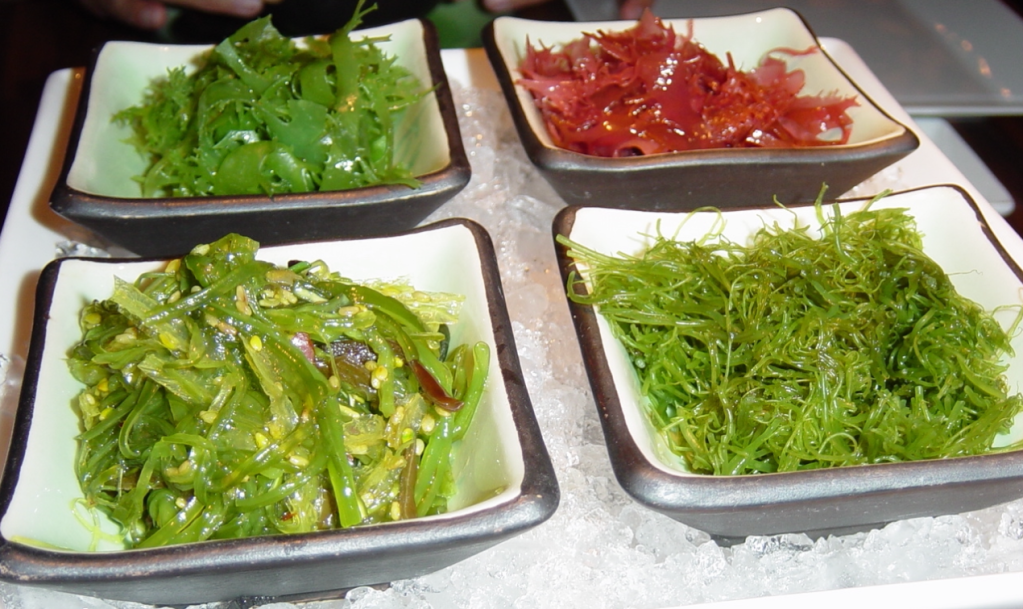
What comes to most peoples minds when they think about seaweed? Is it as an annoying weed that tickles and grabs your foot when swimming in the ocean, or is it as a delightful snack or treat used in sushi?
If seaweed prompted you to think of sushi then you might be on the right line… seaweed has been a very popular food in Asia since the 4th century. It acts as a good source of protein and provides bioactive compounds, making it an ideal product for human and animal consumption (Yong, et al. 2022). With the market for seaweed on the rise in the west (Forster, et al. 2015) could seaweed have the potential to alleviate many of the growing concerns associated with food security?
Food security refers to the ability to provide people with physical and economic access to safe and nutritious food which enables individuals to live a healthy and nutritious life (FAO. 2006). It can be broken down into categories that determine security. Two of these categories are food availability and food access (FAO. 2006). Food availability refers to the supply of food in reference to the ability to produce food (The World Bank/ NA) and food access refers to the physical and economical ability of people to effectively ‘get a hold of’ a sufficient amount of food (The World Bank/ NA).
Food security faces a multitude of challenges. One example of a challenge it faces is population increase surpassing carrying capacity resulting in the estimate that the human demand for food will increase by 70% by 2050. Whilst the demand for food rises exponentially, the ability for supply to meet demand is highly limited for several reasons (Dijon, et al. 2021) some being the lack of land and freshwater, threatened even further by climate change (Forster, et al. 2015).
You may be wondering where seaweed comes into this… seaweed may aid in the mitigation of this crisis by tackling both food availability and food access… but how?
seaweed and Food availability
When hearing the term ‘food availability’ most people may consider supply and demand. Does agricultures production yield sufficient supply to satisfy demand and, if not, how can farmers increase output to reach this?
This is where seaweed comes in. Seaweed may have the potential to increase food availability through adding to agricultural production without taking away land from terrestrial vegetables or cattle. When farmed seaweed does not require man made fertilisers, water cleaners (Mahalik and Kim. 2014). Seaweed has a high productivity and reproduces quickly (Mahadevan. 2015) making it an attractive crop. Seaweed isn’t a new product on our shelves, with current farmed seaweed species being: Laminaria japonica for temperate waters, and Kappaphycus alvarezii for tropical waters (Forster, et al. 2015). Ultimately, farming seaweed and introducing it into the consumer market could lower demand for terrestrial vegetables, creating incentive to reduce supply and freeing up space for land to be used for other things such as re-wilding addressing multiple challenges beyond food sustainability, such as climate change and biodiversity.
climate change
Climate change poses huge challenges to current farming methods, with agricultural land being threatened by desertification in areas such as South America, Spain, etc new methods in farming will be vital in order to maintain food security. One potential solution may be to shift agricultural production from terrestrial land onto marine land through farming seaweed. Seaweed can grow in many climatic conditions so their cultivation has low environmental impact (Mahadevan. 2015). Examples of where they can grow include warm tropics as well as cold and icy polar regions (Mahadevan. 2015) which means they possess great potential as a future food source under new climate change conditions.
In addition to this, nearshore waters are often over enriched with nutrients due to agriculture and sewage leaching leading to algal blooms and loss of biodiversity. By extracting the nutrients through seaweed farming, a valuable environmental service is provided (Forster, et al. 2015) reducing nutrient availability for algae lowering the likelihood of an algal bloom and so enabling a more species rich ecosystem to be maintained.
food accessibility
Cultivation of seaweed can be a profitable activity, especially for coastal communities in developing countries because it has a short production cycle, low capital requirement, and relatively simple farming technology (Mahadevan. 2015). Therefore, seaweed farming could provide thousands of people with long term employment, improving local economies and providing more people to greater access to food.
problems
There are issues surrounding the use of seaweed as a food source. Economic issues include the fact that only coastal communities in maritime nations may benefit from seaweed farming, and these nations must be prepared to sacrifice marine space for seaside farms, which may take away from the extremely lucrative touristic locations. In addition to this products yielded from this must be affordable with a broad consumer appeal otherwise it is not economically viable (Forster, et al. 2015). Therefore in order for seaweed to aid in food sustainability not only must it be affordable and accessible for mass consumption but people must also want to consume it. Would you eat seaweed?
There are environmental limitations such as resource limitation in terms of the availability of inorganic nutrients such as nitrate, phosphate and potassium (Forster, et al. 2015). If farmers start using synthetic fertiliser in seaweed farming the benefits reaped may be undermined due to an increase in nutrient concentration in marine ecosystems increasing the likelihood of algal blooms and once again, lowering biodiversity.
Ultimately, the real question is; if we prioritise yield and profit, will we ever be able to farm sustainably?
Written by Francesca Giannachi-Kaye
Biological Sciences graduate from the University of Exeter
references
Embiricos, G. (2016). The Definitive Guide To Edible Seaweed. Available at: https://www.foodrepublic.com/2016/03/15/the-definitive-guide-to-edible-seaweed/
Forster, J. Radulovich, R. (2015). Seaweed and food security. N/A. Seaweed Sustainability. Academic Press. Available at: https://www.sciencedirect.com/science/article/pii/B9780124186972000118
Yong, W. T. L, Thien, V. T. Rupert, R. R. Rodrigues, K. F. (2022). Seaweed: a potential climate change solution. N/A. Renewable and Sustainable Energy Reviews. Available at: https://www.sciencedirect.com/science/article/pii/S1364032122001459
FAO. (2006). Food security. FAO’s agriculture and development economics devision. 2. Available at: https://www.fao.org/fileadmin/templates/faoitaly/documents/pdf/pdf_Food_Security_Cocept_Note.pdf
The World Bank. (N/A). Seaweed aquaculture for food security, income generation and environmental health in tropical Developing Countries. Available at: https://documents.worldbank.org/en/publication/documents-reports/documentdetail/947831469090666344/seaweed-aquaculture-for-food-security-income-generation-and-environmental-health-in-tropical-developing-countries
Mahadevan, K. (2015). Seaweeds: a sustainable food source. N/A. Seaweed Sustainability. Academic Press. Available at: https://www.sciencedirect.com/science/article/pii/B9780124186972000131
Mahalik, N. et al. (2014). Aquaculture Monitoring and Control systems for seaweed and fish farming. Available at: https://scholarworks.calstate.edu/concern/theses/bv73c1522
Dijk, et al. (2021). A meta-analysis of projected global food demand and population at risk of hunger for the period 2010-2050. Nature food. 2. pp494-501. Available at: https://www.nature.com/articles/s43016-021-00322-9#Sec2
The World Bank. (N/A). What is food security. Available at: https://www.worldbank.org/en/topic/agriculture/brief/food-security-update/what-is-food-security

 All Things Biology