One of my leisure activities is to scroll through apps on my phone, and one of these apps is (as I am someone interested in biology) The New Scientist. There I was about to take my daily vitamin C supplement when an article jumped out at me titled ‘vitamin C and E supplements may make lung cancers grow faster’. I almost choked in my seat. Weren’t vitamins meant to be good for you?
Ok so, I know it’s probably more complicated than that likely over-simplified article, so I thought I would take some time to research into it and look a bit further into this topic.
I will start by outlining the health benefits to taking vitamin C and E:
The NHS states that vitamin C helps protect cells and keeps them healthy, maintaining healthy skin, blood vessels, bones, and cartilage, and, overall, also helping with wound healing (1). You can consume vitamin C naturally through your diet by eating oranges, apples, etc. or you can consume it by supplementing your diet with synthetic vitamins. However, consuming too much vitamin C can have negative effects such as diarrhoea and stomach pain (1).
Vitamin E has health benefits such as maintaining healthy skin and eyes and strengthens the immune system. It can also be acquired through diet by consuming plant oils and nuts and seeds, or it can be consumed through taking synthetic vitamin supplements (2). Vitamin E can be stored in your body for future use, so it’s not actually needed to be consumed every day, putting more people at risk of overconsuming vitamin E but little knowledge is known about the long-term effect over vitamin E over-consumption (2).
Breaking down the article:
I have seen this article being cited on multiple news sites since first viewing it on The New Scientist. To start with, I will summarise the contents of the article.
The main finding from this article is that the over-consumption of vitamin supplements like vitamin C and E might cause lung cancers to grow bigger and make them more likely to spread to other parts of the body (3). It is thought this this may happen due to the vitamin consumption stimulating the formation of blood vessels within tumours. This has been seen in mice both with murine lung cancer and with induced human cancer cells. (3)
One point to highlight is the consumption of these vitamins through diet is not harmful and in fact necessary, especially for people battling illnesses like cancer but supplementing your diet through consuming synthetic vitamins can mean your over-consuming these Vitamins, causing harm. So don’t stop eating foods with these vitamins in, just take fewer or maybe stop consuming synthetic vitamin supplements.
A closer look at the science behind the article… let’s look at the paper itself:
Cancer progression relies on angiogenesis: the formation of new blood vessels to support the growth of tissues (4). This is vital for tumour growth because it enables the tumour to grow to a larger size, as the new blood vessels support it through providing a constant and large enough supply of oxygen and nutrients to the cancer cells (4). In summary: more new blood vessels mean more blood can be supplied to the cancer cells, means there is more oxygen and nutrient availability which means the cancer cells can multiply and the tumour grows larger. So, tumours are inherently reliant on angiogenesis. This is vital knowledge as new treatment techniques now target angiogenesis to treat some types of cancer (4).
Angiogenesis is a response to hypoxia (low oxygen levels) controlled by hypoxia-inducible transcription factors (HIF) and possibly other transcription factors located beyond HIF (5). A transcription factor is a protein which controls the rate of transcription (8)). Transcription is the first step in protein synthesis (where a DNA sequence is copied into an RNA molecule which is later transcribed into a protein) (8).
BACH1 is a significant protein as it is a transcription regulator protein (7) and regulates several physiological processes (9). It is known to promote invasion and increases glucose uptake and glycolysis rates, stimulating glycolysis-dependent (6) metastasis in cancer cells. Metastasis is what enables the cancer cells to spread to other parts of the body. This results in increased mortality rates in patients (9).
The paper found that lung cancer cells exposed to vitamin C and E undergo angiogenesis gene expression (the ‘turning on’ of angiogenesis (8)) under normoxia (normal oxygen levels). This would result in an increase in angiogenesis causing the tumour to grow larger.
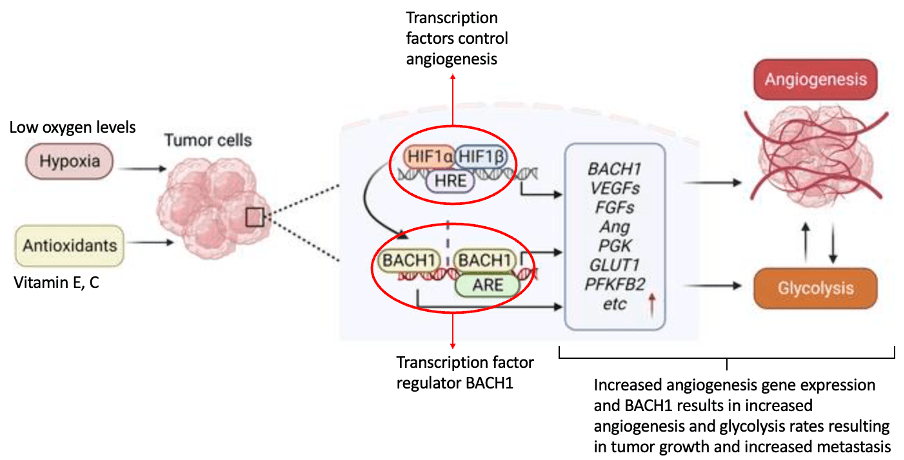
^ taken from paper (5)
The increased expression of angiogenesis due to antioxidants exposure was seen to increase the number of BACH1 overexpressing cells. The study also found BACH1 levels increased with hypoxia (5). This would result in an increase in glycolysis, resulting in the tumour undergoing metastasis.
Ultimately, what we learn from this paper is that overconsumption of antioxidants like vitamin C and E can have negative health impacts. Of course, several pre-existing conditions must be in place for it to have this effect (such as cancer cells must already be in the body) but nevertheless, we should all reconsider how we consume our vitamins as you are likely consuming too much. Further studies should be conducted into other negative effects vitamin overconsumption might have.
However, more can be taken from these findings than just lifestyle choices. The study also saw that the overexpression of BACH1 was also found to make tumours more sensitive to anti-angiogenesis therapy (5). This finding could aid in the progression of more specific cancer treatments. For example, people with high BACH1 levels (like in individuals with lung, breast, or kidney tumours) may benefit more from taking blood vessel growth inhibitors than individuals with low levels of BACH1, making treatments more specific and effective (3). Therefore, further studies should investigate potential therapeutics targeting BACH1 (9).
Written by Francesca Giannachi-Kaye
Biological Sciences graduate from the University of Exeter
References:
- NHS. Vitamin C [internet]. 3/08/2020 [cited 2023 Sep 2]. Available at: https://www.nhs.uk/conditions/vitamins-and-minerals/vitamin-c/
- NHS. Vitamin E [internet]. 3.08/2020 [cited 2023 Sep 2]. Available at: https://www.nhs.uk/conditions/vitamins-and-minerals/vitamin-e/
- Murgugesu, Jason A. Vitamin C and E supplements may make lung cancers grow faster [internet]. 32/08/2023 [cited 2023 Sep 2]. Available at: https://www.newscientist.com/article/2390191-vitamin-c-and-e-supplements-may-make-lung-cancers-grow-faster/
- Eldridge, Lynne. What is Angiogenesis in Cancer? [online]. 8/02/2023 [cited 2023 Sep 2]. Available at: https://www.verywellhealth.com/what-is-angiogenesis-2249047
- Wang, Ting. et al. Antioxidants stimulate BACH1-dependent tumour angiogenesis. The Journal of Clinical Investigation. 31/08/2023. Available at: https://www.jci.org/articles/view/169671
- Wiel, Clotilde et al. BACH1 stabilization by antioxidants stimulates lung cancer metastasis. Cell. 2019. 11;178(2). 330-345. Available at: https://pubmed.ncbi.nlm.nih.gov/31257027/
- Wilikedia. BACH1 [internet]. N/A [cited 2023 Sep 2]. Available at: https://en.wikipedia.org/wiki/BACH1
- Kahn Academy. Transcription factors [internet]. N/A [cited 2023 Sep 2]. Available at: https://www.khanacademy.org/science/ap-biology/gene-expression-and-regulation/regulation-of-gene-expression-and-cell-specialization/a/eukaryotic-transcription-factors
- Padilla, Joselyn. Lee, Jiyoung. A novel therapeutic target, BACH1, regulates cancer metabolism. Cells. 2021. 12;10 (3). 634. Available at:https://pubmed.ncbi.nlm.nih.gov/33809182/
 All Things Biology