The ‘Waggle Dance’ in honeybees can help communicate food source location, distance and quality. New research shows bees are actually learning the dance from their elders, improving communication. But what happens when pesticides are thrown into the mix?
Honeybees (Apis mellifera) are the “most frequent floral visitor in the world” according to Keng-Lou Hung and their team. They pollinate our plants and allow the natural world to flourish. But how do they know where to go? Well, it turns out that these bees use their boogie skills to create a special dance called the ‘waggle dance’ which can tell other bees crucial information about plants nearby. Their movements express where to go, how far to go and the quality of nectar in specific flowers. But how do the bees know how to perform this complex dance? New research has found that social learning is crucial to the accuracy of the dance and that the movements of older bees are copied by younger bees before their first dance. Considering how much information the waggle dance conveys, it’s safe to say it requires complex, coordinated, and deep understanding, being extremely important for honeybee hive health. But it’s not just any bee that can perform this dance and to find out who, we have to delve deeper into the structure of hives themselves.
Understanding how hives or colonies are organised is crucial to appreciating the context of the waggle dance, as it takes a certain type of bee to perform it. Honeybee hives often consist of more than 10,000 bees working together, all allocated different jobs, ensuring great efficiency. The queen is the head of the colony, but she is not involved in this dance, and is rather too preoccupied by mating with the male bees, which are also not the dancing type. Therefore, it’s down to the worker bees, who are all non-fertile females, responsible for many important jobs such as guarding the colony from enemies, cleaning inside the nest and collecting food (foraging). Among this worker bee group are the waggle dancers, which are unsurprisingly the foragers. These foragers have a very important job as their success in finding food (nectar and pollen) is directly linked to colony survival, and the waggle dance is instrumental to increasing chances of success.
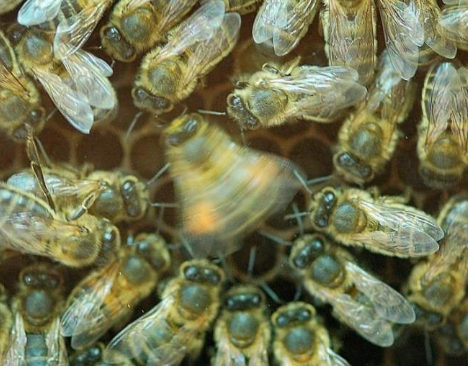
A honeybee performing its waggle dance to other nestmates.
Therefore, the waggle dance is essential to facilitate foraging and requires intricate and precise actions. So, now for the moment we’ve all been waiting for, how do they actually do the waggle dance? Well first, a worker bee will usually find a suitable food source and then will come back to the hive to communicate it to other foragers through dance. Every honeybee hive will have a specific ‘dancefloor’ for it to occur, usually a place near the entrance of the hive. The dancing bee will then position itself on this dancefloor and begin the process. The bee will circle its body in a figure-eight pattern and waggle its abdomen at a certain angle as it moves forward; this is called a waggle run.
This waggle run can be modified by length, angle and number of repeats to communicate different things. The longer the waggle run, the further the distance and the angle of thewaggle run tells other bees in which direction the food is found. As well as this they can communicate quality of food source by increasing the number of repeats. The bees that follow this signal will then fly to the advertised location, come back and dance to recruit more. Overall, the waggle dance is a crucial piece of non-verbal communication that bees use to show other bees where and why to forage in a particular location. Therefore, accuracy is crucial so bees can find the food source more quickly and correctly, otherwise it could lead bees to lower quality food sources or none at all.
The tutor
Young honeybees have been shown to perform their first waggle dance at just 12 days old, but this comes with watching and learning. In fact, a recent 2023 study published in Science by Shihao Dong and their team, showed that young honeybees need to learn this dance from older, more experienced bees to perform it correctly. In the study the team allocated honeybees different groups. One group couldn’t shadow older bees and the other could. They then observed the dance that followed over the course of the bees’ lives. The pattern found is a common theme in nature as young songbirds learn subsongs from more mature voices, rats learn colony dialects from older rats and even human infants, as we know, copy those older than them. So, honeybees have more in common with us than we might think. Their learned experience is essential, as without watching more experienced bees perform the dance before their first routine, more angle and distance errors occur compared to those that have been exposed to the dances of older bees. In fact, usually young worker bees should begin following waggle dancers at 8 days old and have 4 whole days of watching and learning before the big day. But Dong’s Team didn’t just find immediate errors in the waggle run of young honeybees after not observing their elder’s dance. While some errors corrected themselves over time, including angle and direction accuracy, not watching the dance when young meant distance accuracy was never properly recovered. This can affect where other foragers go, especially with changing landscapes and environments. Therefore this ‘tutor’ effect is extremely important for young honeybees.
the wrong angle

The application of pesticides on crops
Pesticides are often used to keep pests away from crops, increasing our food security. However, they can also harm creatures they weren’t supposed to target, such as honeybees. Two studies by Zu Yun Zhang and their team show that some pesticides can actually have an effect on the waggle dance itself, through attacking the bees’ nervous system. The team gave half the honeybees sugar water without pesticide and the other half sugar water with pesticides. They then observed the waggle dances of the bees and found that for both the pesticide deltamethrin and imidacloprid, waggle dance angle, repeats and return phases were increased. The wrong angle could have impacts on the bees watching the waggle dance, as it means they might not arrive at the right source. This could therefore affect how the bees find food and suggests that bees could struggle to find the food sources another bee told them about, reducing the accuracy of communication and potentially reducing the amount of nectar getting to the bees.
But waggle dance angle isn’t the only thing pesticides could alter in honeybees. James Nieh, who was part of Shihao Dong’s team, said that “pesticides might harm their ability to learn how to communicate and potentially even reshape how this communication is transmitted to the next generation of bees in a colony”. This suggests that it not only effects the dance itself but the bees’ ability to teach this dance, from tutor to learner. Which could again result in miscommunication issues, compounding the problem.
Studies such as these really link topical issues together and are important as it can lead to real change. They make us aware that certain pesticides could harm the nervous system of bees, having knock on effect on waggle dance learning and accuracy and therefore overall hive health. This awareness could then translate into action as the information could be taken into consideration when ‘establishing guidelines for the risk assessment of pesticide to honeybee safety’ as said by Zhang and their
team.
In essence, the waggle dance of honeybees is a vital communication tool learnt from their elders and is a great indicator of hive well-being. Recent studies suggest that pesticides might interfere with this dance, potentially disrupting communication within the colony but by understanding and attempting to protecting this dance, we’re not just helping bees find food, we’re safeguarding the health of entire ecosystems through pollination. So, the next time you’re on the dancefloor, take a moment to appreciate the silent language bees are speaking-one that holds the key to the survival of our natural world.

Honeybees searching for nectar in flowers.
Sources
Literature published in the last 12-24months:
Dong, S., Lin, T., Nieh, J.C. and Tan, K. (2023). Social signal learning of the waggle dance in honey
bees. Science, 379(6636), pp.1015–1018. doi:https://doi.org/10.1126/science.ade1702.
Ohlinger, B.D. (2023). Drinking from the Magic Well: Studies on Honeybee Foraging, Recruitment,
and Sublethal Stress Responses using Waggle Dance Analysis. vtechworks.lib.vt.edu. [online]
Available at: https://vtechworks.lib.vt.edu/items/5669c22d-e79e-4053-942f-ff655caa44e2 [Accessed
17 Apr. 2024].
Other pertinent literature and online articles:
Couvillon, M.J., Schürch, R. and Ratnieks, F.L.W. (2014). Waggle Dance Distances as Integrative
Indicators of Seasonal Foraging Challenges. PLoS ONE, [online] 9(4), p.e93495.
doi:https://doi.org/10.1371/journal.pone.0093495.
Hung, K.-L.J., Kingston, J.M., Albrecht, M., Holway, D.A. and Kohn, J.R. (2018). The worldwide
importance of honey bees as pollinators in natural habitats. Proceedings of the Royal Society B:
Biological Sciences, [online] 285(1870), p.20172140. doi:https://doi.org/10.1098/rspb.2017.2140.
Okada, R., Hidetoshi Ikeno, Hitoshi Aonuma, Midori Sakura and Ito, E. (2023). Honey Bee Waggle
Dance as a Model of Swarm Intelligence. Journal of robotics and mechatronics, 35(4), pp.901–910.
doi:https://doi.org/10.20965/jrm.2023.p0901.
Univerisity of California (2023). Complex Learned Social Behavior Discovered in Bee’s ‘Waggle Dance’.
[online] Lab Manager. Available at: https://www.labmanager.com/complex-learned-social-behavior-
discovered-in-bee-s-waggle-dance-29939 [Accessed 22 Apr. 2024].
Zhang, Z.Y., Li, Z., Huang, Q., Yan, W.Y., Zhang, L.Z. and Zeng, Z.J. (2020a). Honeybees (Apis mellifera)
modulate dance communication in response to pollution by imidacloprid. Journal of Asia-Pacific
Entomology, 23(2), pp.477–482. doi:https://doi.org/10.1016/j.aspen.2020.03.011.
Zhang, Z.Y., Li, Z., Huang, Q., Zhang, X.W., Ke, L., Yan, W.Y., Zhang, L.Z. and Zeng, Z.J. (2020b).
Deltamethrin Impairs Honeybees (Apis mellifera) Dancing Communication. Archives of Environmental
Contamination and Toxicology, [online] 78(1), pp.117–123. doi:https://doi.org/10.1007/s00244-019-
00680-3.
By Sabrina Giampieri-Smith
 All Things Biology