Fermented foods have long been labelled as cultural, culinary and health staples around the world, but recent research from 2023 reveals only two of those may be true.

Christina Vetter and Cecilia Jennings, 2024
Almost exactly one year ago I sat in a lecture which changed my perception of food, health, and everything. That may sound exaggerated, but I am completely serious. A year ago, I sat in Dr Katie Solomon’s second-year lecture on the human microbiome and its role in disease. I learnt about the role of the gut microbiome in diabetes, obesity, cardiovascular disease, neurodegenerative disorders and even depression.
I was left curious, itching for more and the internet provided that: probiotics, prebiotics, and fermented foods. Rapidly, I learnt how what we eat changes our gut microbiome. I discovered social media lifestyle influencers, doctors, and scientific publications with one message: fermented foods will change your life.
So, what did I do? Of course, I started eating fermented foods, every day. After one year of apple cider vinegar, kefir yoghurt, kimchi snacks and more, I thought, to what extent are fermented foods improving my overall health?
Fermented foods and the media machine:
The media machine (own image)
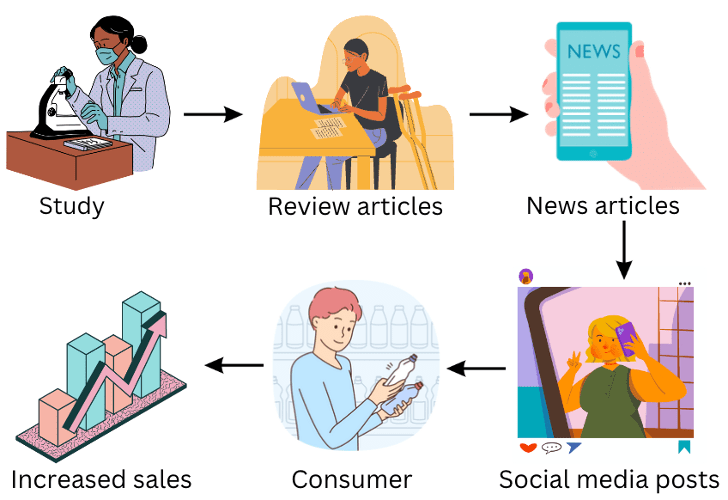
In 2021 came an explosion of studies with one primary focus: how fermented foods improve overall health. For example, in 2021 Dr Christopher Gardner and fellow researchers from Stanford University conducted a 10-week study on the effect of a diet high in fermented foods on human health and found consumption of fermented foods increased microbial diversity and lowered inflammation. Following studies like these, popular Scientific journals like Nature started publishing review articles such as Karen O’Leary’s review of Dr Christopher Gardner’s work, grounding the health benefits provided by fermented foods into the scientific communities’ discussion platforms. Not long after this, news platforms pushed articles like Anahad O’Connor’s New York Times article linking the consumption of fermented foods to lower rates of obesity, type 2 diabetes, metabolic disease and, as they put it, “other ills”. The broadcasting of the benefits of fermented foods on popular news sites unsurprisingly led to an explosion of posts on social media from influencers like Lacy Baier’s video titled ‘5 Reasons Why I Eat Fermented Foods: My Top 9 Fermented Foods for Your Health’ which amassed 112 thousand views.
Likely following increased media attention on the health benefits of fermented came a sudden boom in fermented food sales. A review of fermented food statistics by Shahbandeh in 2024 found probiotic yoghurt sales in 2021 exceeded one billion euros in the UK, the fermented food and beverage market reached retail sales of just under 11 billion dollars in the US in 2021. Sales are only increasing; it is estimated that between 2022 and 2032 the global kefir market will grow by over 500 million dollars.
In 2024 the social media push for fermented foods continues, as demonstrated by a video published on ZOE’s (a healthy eating app) YouTube channel, which has 509K subscribers. In this video, ZOE’s co-founder, Professor Tim Spector suggested trying fermented foods to promote gut health and immunity he says, “Kefir is increasing in popularity, is like a super yoghurt […] often has 10-20 different types of microbes” and encourages consumers to incorporate it as part of their breakfast.
If studies have shown fermented foods benefit your health, why is the media’s representation a problem?
The filtering of communication from specialists conducting studies and writing review articles in Nature to non-specialists writing news articles to members of the public or professionals selling products creating social media posts for capital gain results in a loss of vital information, causing an inaccurate display of the health benefits provided by fermented foods.
It has been long understood in the scientific community that many of the health benefits associated with the consumption of fermented and probiotic foods that are pushed onto the public are exaggerations of published results. When asking expert Dr Katie Solomon from the University of Exeter for her opinion she said the “misrepresentation of data or sensationalist representation for commercial gain is often a problem”.
Maria Marco and her research group investigated this matter by re-assessing the benefits of fermented foods in a 2021 review and emphasised how the internet and popular magazines often amplify the benefits consuming fermented foods provides. They found health benefits associated with products like kimchi, milk kefir, sauerkraut, natto, vinegar and sourdough bread are founded on very few trials and other products like kombucha have not been investigated in humans, evidence relies only on chemical analysis, animal and cell culture models.
The ‘bad’ of fermented foods:
I have outlined how the benefits of fermented foods are often misrepresented in the media, likely resulting in people purchasing and consuming products with unrealistic expectations of the health benefits provided by them. But could it be worse than that? Could consuming fermented foods negatively impact your health?
Rachael Duche and colleagues’ recent publication sheds new light on the health benefits provided by fermented foods. Their 2023 study exposed lactic acid bacteria strains from fermented foods sourced from Nigeria to different antibiotics and identified resistance-coding genes. Other studies from across the world support Duche and her team’s results. In 2023 Yuli Haryani and colleagues found multiple antibiotic-resistant genes in fermented food-associated lactic acid bacteria in Malaysia, Anup Kumar Ojha and colleagues found it in traditional Indian food products and Promiselynda Obioha and colleagues saw antibiotic resistance in Nono, a traditional naturally fermented milk product consumed across West Africa.
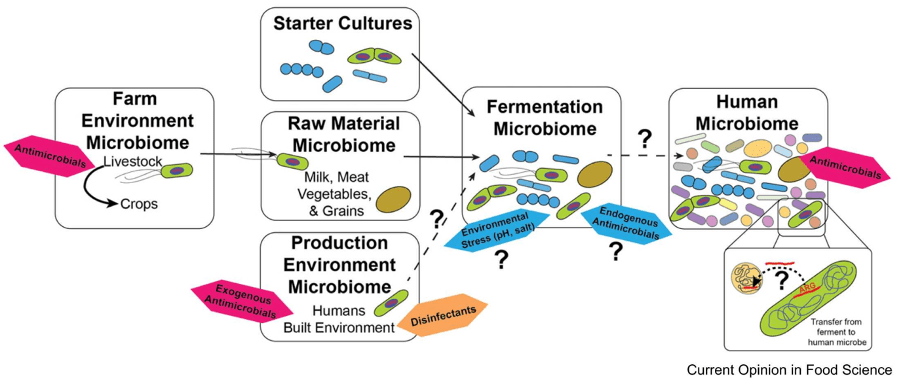
Microbes with antibiotic-resistant genes may be introduced into fermented foods during the production system from animal products and crop systems. Benjamin Wolfe’s 2023 review article highlighted how fermented foods provide a farm-to-gut pipeline for current and future antimicrobial resistance in our food supply.
Benjamin Wolfe, 2023
This diagram taken from Wolfe’s review article provides a storyline of how microbes with antibiotic-resistant genes could migrate from fermented foods to the gut microbiome. The green cells represent microbes with antibiotic-resistant genes and the dashed arrows indicate connections between food systems that have not yet been established but Wolfe suggests could exist, the question marks represent unknowns.
Could this pose a serious health threat to a world consuming fermented foods on a mass scale?
Some studies like Tutong and colleagues label the antibiotic-resistant genes present in food systems as a public health risk due to the likelihood of these microbes joining our gut microbiome. But expert Katie Solomon emphasised how fermented foods act as an ecosystem, like soil, plant surfaces and the human gut. Therefore, like these other ecosystems, the presence of antibiotic-resistant genes is a part of the competitive battle that enables species to thrive and combat others. She stated how “these genes mainly become a threat to human health if they are acquired by a pathogenic species that is otherwise treatable by a specific class of antimicrobials.”
But a 2023 study by Li Yutong and colleagues found antibiotic resistance in lactic acid and pathogens such as Klebsiella pneumoniae and Entercoccus in retail kimchi and artisan cheeses and a 2011 study by Muhammad Nawaz and colleagues found lactic acid bacteria in fermented foods from China could acquire resistance to penicillin, erythromycin, clindamycin, and tetracycline, all common antibiotics used today.
Ultimately, though antibiotic-resistant genes have been detected in fermented foods in non-harmful microbes and pathogens, the health risk remains low and there have been no known cases of humans being harmed by resistant microbes. Dr Solomon highlighted how there is a “larger reservoir of antimicrobial-resistant genes already in our gut microbiome”.
The risk of fearmongering in the media:
Concerning fermented food, it is in the inaccurate portrayal of the benefits where the greatest threats to human health lie. In 2019 Manal Mohammed, a lecturer in medical microbiology at the University of Westminster, published a news article in the Independent titled ‘Why fermented foods could cause serious harm to your health’ in which he outlined the ‘severe side effects’ of consuming fermented foods including bloating, headaches, infection, and antibiotic resistance. Though Manal’s points are grounded in science, the language and examples used exaggerate the effect on human health and can be likened to fearmongering. For example, the title states ‘serious harm’ but the first two examples provided by Manal are not serious health risks (bloating and headaches). Though Manal acknowledges “most people will be fine eating fermented foods” in the final sentence of the article, for many members of the public the title would have already persuaded them to throw away their kefir and kimchi and never touch a fermented product again.
With an increase in publications outlining the presence of antibiotic-resistant microbes in fermented foods, will news and media publications suddenly start fearmongering this information? The answer is likely, yes… be prepared for clickbait news articles titled ‘Why fermented foods cause antibiotic resistance’ and influencers posting videos titled ‘The reason why I stopped consuming fermented foods.’ Ultimately, the presence of antibiotic resistance in fermented foods is not a public health risk but a symptom of antibiotic resistance in ecosystems and food systems. What poses a greater public health risk is the miscommunication of science in the media and the impact this has on individuals’ lifestyles, views, consumption and ultimately, health.
Written by Francesca Giannachi-Kaye
References:
Main focal papers published in the past 12-24 months:
- Balasubramanian R., Schneider E., Gunnigle E., Cotter P. D., Cryan J. F., (2024) ‘Fermented foods: Harnessing their potential to modulate the microbiota-gut-brain axis for mental health’. Neuroscience and Biobehavioral Reviews. 158:105562. Available at: https://pubmed.ncbi.nlm.nih.gov/38278378/ (Accessed: 22/04/24)
- Duche R. T., Singh A., Wandhare A. G., Sangwan V., Sihag M K., Nwagu T. N. T., Panwar H., Ezeogu L I. (2023) ‘Antibiotic resistance in potential probiotic lactic acid bacteria of fermented foods and human origin from Nigeria’. MBC Microbiology. 23:142. Available at: https://pubmed.ncbi.nlm.nih.gov/37208603/ (Accessed: 22/04/24)
- Haryani Y., Halid N. A., Guat G. S., Nor-Khaizura M. A. R., Hatta M. A. M., Sabri S., Radu S., Hasan H., (2023) ‘High prevalence of multiple antibiotic resistance in fermented food-associated lactic acid bacteria in Malaysia’. Food Control. 147:109558. Available at: https://typeset.io/papers/high-prevalence-of-multiple-antibiotic-resistance-in-1iwgz7n8 (Accessed: 20/04/24)
- Li Y., Fu S., Klein M S., Wang H., (2023) ‘High prevalence of antibiotic resistance in traditionally fermented foods as a critical risk factor for host gut antibiotic resistome’. BioRxiv. Available at: https://www.biorxiv.org/content/10.1101/2023.04.21.537834v2 (Accessed: 22/04/24)
- Obioha P. I., Anyogu A., Awamaria B., Ghodduis H. B., Ouoba L. I. I., (2023) ‘Antimicrobial Resistance of Lactic Acid Bacteria from Nono, a Naturally Fermented Milk Product’. Antibiotics. 12(5):843. Available at: https://www.mdpi.com/2079-6382/12/5/843 (Accessed: 20/04/24)
- Wolfe B. E. (2023) ‘Are fermented foods an overlooked reservoir of antimicrobial resistance?’. Current Opinion in Food Science. 51:101018. Available at: https://www.sciencedirect.com/science/article/abs/pii/S2214799323000322 (Accessed: 20/04/24)
Other literature and online articles cited:
- Abriouel H., Knapp C. W., Galvez A., Benomar N., (2017) ‘Chapter 29- Antibiotic Resistance Profile of Microbes from Traditional Fermented Foods’. Fermented Foods in Health and Disease Prevention. 675-704. Available at: https://www.sciencedirect.com/science/article/abs/pii/B9780128023099000297. (Accessed: 19/04/24)
- Bell V., Ferrao J., Pimentel L., Pintado M., Fernandes T., (2018) ‘One Helath, Fermented Foods, and Gut Microbiota’. Foods. 7(12): 195. Available at: https://www.ncbi.nlm.nih.gov/pmc/articles/PMC6306734/ (Accessed: 22/04/24)
- Baier, L. (2021) 5 Reasons why I eat Fermented Foods + My Top 8 Fermented Foods for your healthAvailable at: https://www.youtube.com/@laceybaier_
- Debret, C. (2021) History of fermentation around the world. Available at: https://stacker.com/food-drink/history-fermentation-around-world
- Louw N. L., Lele K., Ye R., Edward C. B., Wolfe B. E., (2023) ‘Microbiome Assembly in Fermented Foods’. Annual Review of Microbiology. 77:381-402. Available at: https://www.researchgate.net/publication/373956182_Microbiome_Assembly_in_Fermented_Foods (Accessed: 22/04/24)
- Marco M. L., Sanders M. E., Gänzle M., Arrieta M. C., Cotter P. D., Vuyst L. D., Holl C., Holzapfel W., Lebeer S., Merenstein D., Reid G., Wolfe B. E., Hutkins R. (2021) ‘The International Scientific Association for Probiotics and Prebiotics (ISAPP) consensus statement on fermented foods’. Nature Reviews. 18. Available at: https://pubmed.ncbi.nlm.nih.gov/33398112/ (Accessed: 19/04/24)
- Mohammed, M. (2019) ‘Why fermented foods could cause serious harm to your health’ Independent, Available at: https://www.independent.co.uk/news/science/fermented-food-gut-health-digestion-kimchi-kombucha-sourdough-a9204226.html
- Nawaz M., Wang J., Zhou A., Ma C., Wu X., Moore J. E., Millar B. C., Xu J., (2011) ‘Characterisation and transfer of antibiotic resistance in Lactic Acid Bacteria from Fermented Food Products’. Current Microbiology. 62: 1061-1089. Available at: https://pubmed.ncbi.nlm.nih.gov/21212956/ (Accessed: 22/04/24)
- O’Connor, A. (2021) ‘How fermented foods may alter your microbiome and improve your health’ The New York Times, Available at: https://www.nytimes.com/2021/08/13/well/eat/yogurt-kimchi-kombucha-microbiome.html
- O’Leary K., (2021) ‘Health benefits of fermented foods’. Nature. Available at: https://www.nature.com/articles/d41591-021-00053-1 (Accessed: 22/04/24)
- Saxe, L. (2019) Fermented Foods are up 149%- as long as they’re unfamiliar. Available at: https://www.forbes.com/sites/lizzysaxe/2019/02/06/fermented-foods-are-up-149-percent-as-long-as-theyre-unfamiliar/?sh=c3d5aa9673fd
- Shahbandeh, M. (2024) Fermented foods- statistics and facts. Available at: https://www.statista.com/topics/10951/fermented-food-market/#topicOverview
- Tiedje J. M., Fu Y., Mei Z., Schaffer A., Dou Q., Amelung W., Elsner M., Adu-Gyamfi J., Heng L., Virta M., Jiang X., Smift H., Topp E., Wang F., (2023) ‘Antibiotic resistance genes in food production systems support One Health options’. Environmental Science and Health. 34:100492. Available at: https://pubmed.ncbi.nlm.nih.gov/25918831/(Accessed: 22/04/24)
- Vetter, C. Jennings, C. (2024) Top fermented foods you can add to your diet. Available at: https://zoe.com/learn/top-fermented-foods
- Weaver, J. (2021) Dr Christopher Gardner and Co-Authors Discover Fermented-Food Diet Increases Microbiome Diversity and Lowers Inflammation. Available at: https://humanbiology.stanford.edu/news/dr-christopher-gardner-co-authors-discover-fermented-food-diet-increases-microbiome-diversity
 All Things Biology